> For the complete documentation index, see [llms.txt](https://docs.shimoku.com/dev/llms.txt). Markdown versions of documentation pages are available by appending `.md` to page URLs; this page is available as [Markdown](https://docs.shimoku.com/dev/building-web-app/environment/environment-variables.md).
# Environment Variables
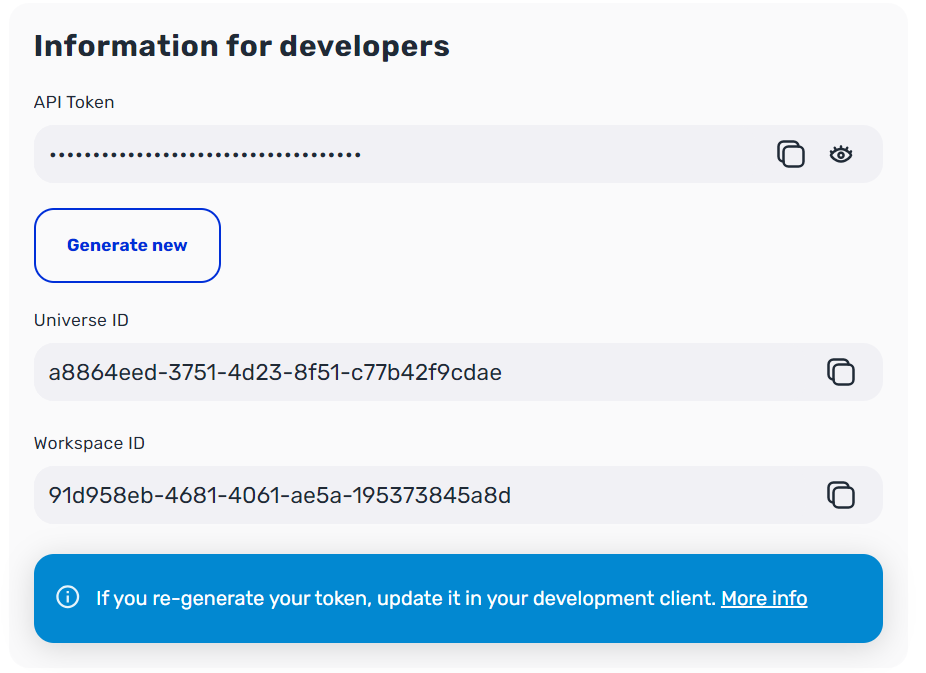
Environment variables are dynamic values that are **set outside** of the main program and are used by various processes running on the SDK. These variables contain information about the system environment, such as the `SHIMOKU_TOKEN`, the `UNIVERSE_ID` or the `WORKSPACE_ID`, that are **specific** **for every user** and **must not be shared**.
Using a `.env` file, the values of the variables can be stored, and using a `.gitignore` file, the git processes will ignore them, thus will not publish them.
***
When creating a project in the SDK you will encounter a code similar to this:
from os import getenv
from shimoku import Client
from dotenv import load_dotenv

load_dotenv()

access_token = getenv('SHIMOKU_TOKEN')
universe_id: str = getenv('UNIVERSE_ID')
workspace_id: str = getenv('WORKSPACE_ID')

//[...]
The `getenv()` function returns the value of the variable stored in the `.env` file, indicated in the parameters:
{% code title=".env" %}
```makefile
SHIMOKU_TOKEN=your_access_token_here
UNIVERSE_ID=your_universe_id_here
WORKSPACE_ID=your_workspace_id_here
```
{% endcode %}
To access these credentials, log into your account on [Shimoku.io](https://shimoku.io/), click on the top-right corner **User Icon** and then on **Settings > Information For Developers**.
{% hint style="info" %}
If you do not have an account, check [Shimoku Cloud](/dev/cloud-and-community/shimoku-cloud.md)
{% endhint %}
Finally, to ensure that none of this values can be published when using git tools, create a `.gitignore` file and add the `.env` file:
{% code title=".gitignore" %}
```gitignore
# Ignore files containing sensitive environment variables
.env
# Ignore any other files or directories as needed
#[...]
```
{% endcode %}
---
# Agent Instructions
This documentation is published with GitBook. GitBook is the documentation platform designed so that both humans and AI agents can read, navigate, and reason over technical content effectively. Learn more at gitbook.com.
## Querying This Documentation
If you need additional information that is not directly available in this page, you can query the documentation dynamically by asking a question.
Perform an HTTP GET request on the current page URL with the `ask` query parameter, and the optional `goal` query parameter:
```
GET https://docs.shimoku.com/dev/building-web-app/environment/environment-variables.md?ask=&goal=
```
`ask` is the immediate question: it should be specific, self-contained, and written in natural language.
`goal` is optional and describes the broader end goal you are ultimately trying to accomplish on behalf of the user. GitBook uses it to tailor the answer towards what is most useful for that goal.
The response will contain a direct answer to the question and relevant excerpts and sources from the documentation.
Use this mechanism when the answer is not explicitly present in the current page, you need clarification or additional context, or you want to retrieve related documentation sections.